Angels
The Snow QueenAngels appear as Gerda’s protectors in the frozen approach to the Snow Queen’s castle: her prayer takes visible form in the steam of her breath, and the resulting host drives back the castle’s living snowflake guards. Their intervention turns prayer into practical rescue, clearing Gerda’s path and easing the cold that threatens her.
Appearance and Arrival
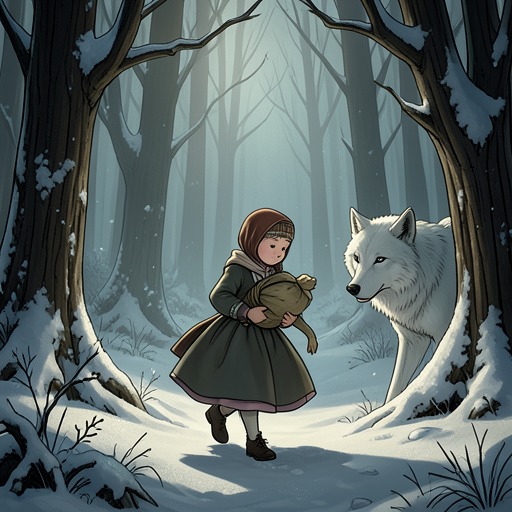
The Angels arrive after Gerda reaches Finland without shoes or gloves. A regiment of snowflakes advances across the ground beneath a clear sky lit by the northern lights. The shapes grow larger as they approach: some resemble porcupines, others twisted serpents, and others small, bristling bears. They are not ordinary falling flakes but living guards of the Snow Queen.
Gerda recalls how large and beautiful the snowflakes had looked through the burning-glass, but these are larger still, and terrible because they are alive. She begins reciting the Lord’s Prayer. In the intense cold, her breath emerges as steam; as she continues, the steam increases and takes the shape of little Angels. They grow larger as soon as they touch the earth.
Defense of Gerda
The Angels carry helmets, spears, and shields. Their numbers keep increasing until, when Gerda finishes her prayer, a whole legion stands around her. They thrust their spears into the snowflake guards, breaking them into a hundred pieces. The enemy’s destruction opens a route forward: Gerda can proceed with courage and safety toward the Snow Queen’s castle.
Their aid is not limited to combat. The Angels stroke Gerda’s hands and feet, reducing the cold she feels, and she hastens onward. The scene thus gives their protection both a martial and a bodily form: they defeat the immediate threat while also helping the unshod, ungloved child endure the frozen terrain.
Narrative and Religious Significance
The episode makes the act of prayer the immediate circumstance of the Angels’ arrival. Their emergence from Gerda’s breath gives spiritual language a material consequence within the action: the prayer is followed by defenders who overcome a danger she could not safely pass alone. The contrast is especially sharp between the threatening snowflakes, which move across the ground in monstrous shapes, and the Angels, whose orderly armor and weapons turn that same landscape into a traversable path.
The story’s ending returns to Christian language without depicting the Angels again. At home, the grown Gerda and Kay hear their grandmother read, “Except ye become as little children, ye shall in no wise enter into the kingdom of God.” They then understand the childhood hymn, “Roses bloom and cease to be, / But we shall the Christ-child see.” This final framing echoes the faith associated with Gerda’s prayer in Finland, while the Angels’ particular role remains the concrete rescue that carries her onward.